


Universal Media Compatibility
Resistant to virtually all industrial chemicals, acids, alkalis and solvents across the full pH range. No extractable impurities, no leaching into the filtrate.


A seamless, micro-porous PTFE tube engineered by paste extrusion and controlled stretching. Delivers uniform pore structure, universal chemical resistance and reliable performance from −80 °C to +250 °C — validated for pharmaceutical, chemical, food and electronics filtration.
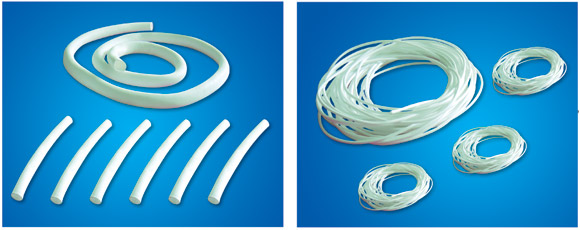
PTFE Micro-Porous Filtration Tube is made from PTFE fine powder. Through a special elasticity process, it forms homogeneous micropores. It is anti-corrosive, high and low temperature resistant, and suitable for water and gas filtration.
It is widely used in chemical water and gas filtration, pharmaceutical industry filtration, and corrosive liquid filtration.
Unlike sintered metal or ceramic filters, micro-porous PTFE tubing combines broad chemical inertness with a flexible, non-shedding structure. The result is a filtration element that handles aggressive liquids and gases without contaminating the process stream.
Resistant to virtually all industrial chemicals, acids, alkalis and solvents across the full pH range. No extractable impurities, no leaching into the filtrate.
Performs reliably in cryogenic sampling lines and high-temperature process streams. No embrittlement, no softening within the rated operating window.
Pore size is tunable from 0.2 μm to 100 μm with 60–80% porosity, delivering high permeability without sacrificing particle retention.
The microfibrous PTFE structure does not shed fibers or particles into the filtrate — critical for pharmaceutical, food-contact and semiconductor applications.
Seamless construction allows bending and routing without cracking. Ideal for compact filtration modules and instrumentation lines where rigid elements cannot fit.
Raw materials and finished tubing comply with FDA 21 CFR 177.1550 and USP Class VI requirements, with full material certificates available.
Standard and custom dimensions available. Pore size, wall thickness, inner diameter and length can be tailored to your filtration module design.
| Parameter | Standard Range | Notes |
|---|---|---|
| Material | 100% virgin PTFE (fine powder resin) | No fillers, no pigments |
| Pore Size | 0.2 μm – 100 μm | Custom pore size available on request |
| Porosity | 60% – 80% | Higher porosity = higher permeability |
| Tensile Strength | ≈ 10 MPa | Microfibrous structure |
| Working Temperature | −80 °C to +250 °C | Short-term peaks may be higher |
| Wall Thickness | 0.8 – 1.2 mm (typical) | Can be customized |
| Outer Diameter | 2.5 – 180 mm | Liquid vs. gas applications differ |
| Length | Cut to order | Up to 1000 mm standard; longer negotiable |
| Surface Finish | Smooth, non-porous outer skin available | For handling and sealing |
| Sterilization | Autoclavable | Repeated autoclave cycles supported |
| Pore Size | Typical Application | Filtration Type |
|---|---|---|
| 0.2 – 0.5 μm | Sterile filtration, gas venting, pharmaceutical | Microfiltration / sterile barrier |
| 1 – 5 μm | Fine chemical filtration, sample preparation | Microfiltration |
| 10 – 30 μm | General chemical and water filtration | Particulate removal |
| 50 – 100 μm | Coarse pre-filtration, gas diffusion | Pre-filtration / sparging |
PTFE micro-porous filtration tubes are specified wherever aggressive media, high purity or thermal extremes rule out conventional filter materials.
Sterile filtration, venting, sample preparation and CIP/SIP-compatible process lines.
Acid, alkali and solvent filtration; corrosive liquid and gas streams.
Food-contact filtration, steam and gas filtration where FDA compliance is required.
High-purity chemical filtration, photoresist and etchant handling.
Air monitoring, stack sampling and laboratory filtration tubing.
Gas diffusion, sparging and filtration in fuel cells and industrial gas systems.
The pore structure is created by mechanical stretching, not by sintering or chemical foaming. This process gives precise control over pore size, porosity and mechanical integrity.
Material certifications are available for every order. These documents support regulatory submissions, supplier qualification and internal quality audits.
| Certification / Standard | Scope | Availability |
|---|---|---|
| FDA 21 CFR 177.1550 | PTFE resin for food-contact and pharmaceutical use | Certificate of conformity with each batch |
| USP Class VI | Biological reactivity testing for medical and pharma applications | Compliance statement available |
| ISO 9001 | Quality management system at manufacturing facility | Certificate on request |
| REACH & RoHS | Restricted substances compliance | Declaration available |
| BSE / TSE Free | Animal-derived ingredient declaration | Statement available |
| Material Traceability | Batch-level resin traceability | Batch certificate issued |
Technical and procurement questions from engineers and purchasing teams.
For sterile filtration and gas venting, 0.2 μm is the standard rating. For general particulate removal, 1–10 μm is common. If you are unsure, provide your target retention and flow rate requirements, and we can recommend a pore size.
Native PTFE is hydrophobic (water-repellent). For liquid/aqueous filtration, the tube is treated to be hydrophilic so water-based media can pass through. For gas filtration and venting, the hydrophobic form is often preferred. Please specify your medium when ordering.
Yes. PTFE micro-porous tubing withstands autoclave cycles, steam-in-place (SIP) and clean-in-place (CIP) procedures within the rated temperature range. No material degradation is expected under normal sterilization protocols.
It depends on wall thickness, pore size and tube diameter. Thicker walls and smaller pore sizes tolerate higher differential pressures. Please share your pressure conditions and we will confirm the appropriate wall thickness and configuration.
Yes. Free samples are available for standard sizes, with freight paid by the buyer. Custom pore sizes and dimensions can be quoted as evaluation samples. Contact us with your specification.
Standard sizes ship in 5–10 days; custom pore sizes and dimensions typically take 10–20 days. MOQ is flexible and trial orders are accepted. Lead time is confirmed at quotation based on specification and quantity.
FDA 21 CFR 177.1550 conformity, USP Class VI compliance statement, ISO 9001 quality management, REACH/RoHS declarations and BSE/TSE-free statements are available. Request the specific documents needed for your project at the inquiry stage.
Send us your pore size, inner/outer diameter, wall thickness, length, quantity and operating conditions (medium, temperature, pressure differential, and whether the tube will be used for liquid or gas filtration). We will reply within 24 hours with price, lead time and a technical recommendation.
Get Your Custom QuoteAddress
No. 432 Zhenhai Middle Road, Luotuo Street, Zhenhai District, Ningbo City, Zhejiang China


