
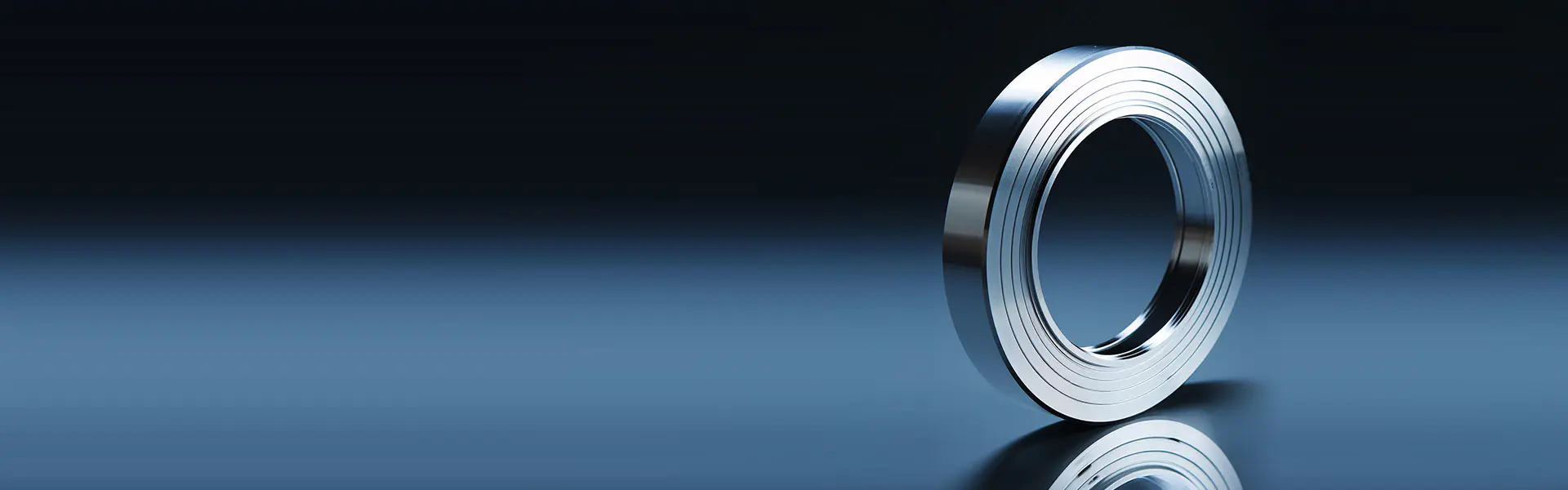
In the intricate world of industrial sealing, where pressure, temperature, and media compatibility are constant challenges, finding a reliable and resilient gasket solution is paramount. Corrugated gaskets stand out as a superior choice for a wide range of critical applications. At Kaxite Sealing, with our decades of expertise in advanced sealing technology, we engineer corrugated gaskets that deliver unparalleled performance, longevity, and safety in the most demanding environments. These gaskets are not merely components; they are precision-engineered barriers designed to maintain system integrity, prevent leaks, and ensure operational efficiency.
The unique construction of a corrugated gasket combines a metallic core—often stainless steel, copper, or other alloys—with a soft filler material, such as graphite, PTFE, or ceramic. This hybrid design leverages the strength and resilience of metal with the conformability and sealing properties of the non-metallic filler. The corrugated (wavy) pattern of the metal core provides exceptional spring-like behavior, allowing the gasket to compensate for flange irregularities, thermal cycling, and system vibrations. This results in a tight, durable seal that maintains its clamping force over extended periods, far outperforming many flat gasket types.
Selecting the correct corrugated gasket requires a detailed understanding of its parameters. Kaxite Sealing provides comprehensive specifications to ensure perfect compatibility with your system's requirements.
The performance of a corrugated gasket is largely defined by its material combination. Below are our standard configurations:
| Parameter | Specification Range & Details | Kaxite Sealing Standard |
|---|---|---|
| Standard Sizes (Inner Diameter) | 15 mm (1/2") to 1500 mm (60") and larger custom sizes | Full range available, custom machining on request |
| Thickness (Total) | 3.0 mm (1/8") to 4.5 mm (3/16") standard; other thicknesses available | 3.2 mm and 4.5 mm are most common |
| Pressure Rating | Up to 300 Bar (≈ 4350 PSI), depending on material and design | Individually rated per ASME B16.20/B16.5 standards |
| Temperature Range | -240°C to +1000°C (-400°F to +1832°F), contingent on filler material | Graphite: -240°C to 550°C (inert), Ceramic: up to 1000°C |
| Corrugation Pitch & Depth | Fine (for higher pressure) and Coarse (for better compression) patterns | Optimized for optimal stress distribution and sealability |
| Standards Compliance | ASME B16.20, B16.5, API 6A, DIN, EN, JIS, GOST | Full traceability and certification available (MTC) |
| Surface Treatments | Electroplating (Tin, Nickel), PTFE Coating, Oxidation Resistance Coatings | Applied to enhance corrosion resistance and reduce friction |
Q: What are the main advantages of corrugated gaskets over spiral wound gaskets?
A: While both are excellent for high-performance applications, corrugated gaskets offer distinct benefits. They typically require a lower bolt load to achieve an effective seal, reducing stress on flanges. Their uniform, all-over corrugated structure often provides more consistent sealing pressure distribution. They are also generally less prone to over-compression and can be more cost-effective for certain sizes and pressure ranges. Kaxite Sealing experts can help determine which type is optimal for your specific service conditions.
Q: Can corrugated gaskets be used for heat exchangers?
A: Absolutely. They are a premier choice for shell-and-tube and plate heat exchangers. Their ability to handle thermal cycling, high temperatures, and varying pressures makes them ideal. For heat exchanger applications, Kaxite Sealing often recommends a stainless steel core with a flexible graphite filler, which offers excellent thermal conductivity and stability across the wide temperature gradients common in these units.
Q: How do I select the right metal and filler material for my application?
A: Material selection is a critical three-factor analysis:
1. Media Compatibility: The filler and metal must resist corrosion/attack from the internal fluid. Chemical resistance charts for PTFE, graphite, and metals are essential guides.
2. Temperature: The operating temperature defines the filler choice (e.g., PTFE up to 260°C, graphite up to 550°C in oxidizing atmospheres, ceramic for higher).
3. Pressure: The metal core thickness and corrugation design are selected based on system pressure. Consulting with Kaxite Sealing's engineering team is strongly advised to navigate these parameters and ensure a safe, reliable selection.
Q: Are corrugated gaskets reusable?
A: Corrugated gaskets are generally designed as single-use, critical-sealing components. The act of compressing the gasket during installation causes the soft filler to deform and flow into the flange imperfections, creating a unique seal. Reusing a gasket that has already been compressed and potentially work-hardened can compromise its sealing ability and recovery properties, leading to potential leaks. For reliability and safety, Kaxite Sealing recommends always using a new gasket during reassembly.
Q: What flange surface finish is required for corrugated gaskets?
A: They are relatively forgiving compared to solid metal gaskets. A serrated concentric or phonographic (spiral) finish in the range of 125 to 250 µin Ra (3.2 to 6.3 µm Ra) is typically recommended. A smooth, mirror-like finish is not necessary and can sometimes be detrimental. The corrugations and filler are designed to bite slightly into these serrations, enhancing the seal. Kaxite Sealing can provide specific surface finish recommendations based on your gasket material and operating conditions.
Q: How does Kaxite Sealing ensure the quality of its corrugated gaskets?
A: At Kaxite Sealing, quality is engineered into every step. We use certified raw materials with full traceability. Our manufacturing process employs precision CNC-controlled forming tools to ensure consistent corrugation geometry and filler thickness. Every production batch undergoes rigorous dimensional checks. We perform sample testing for critical parameters like density, recovery, and sealability. Certificates of Conformance and Material Test Reports are provided to meet the stringent requirements of the oil & gas, chemical, pharmaceutical, and power generation industries.
The versatility of our corrugated gaskets makes them suitable for a vast array of industries. Their reliability is proven in systems where failure is not an option.
Kaxite Sealing is more than a supplier; we are a sealing solutions partner. We understand that standard solutions do not always fit unique challenges. Therefore, we offer extensive customization capabilities for our corrugated gaskets:


